
Feminist climate policy in industrialised states: a gender-just climate emergency response
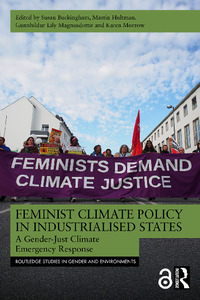
Buckingham, Susan ; Hultman, Martin ; Magnusdottir, Gunnhildur Lily ; Morrow, Karen
Routledge - London
2025
307 p.
climate change ; feminist movement ; gender equality ; environmental policy ; social policy
Environment
https://doi.org/10.4324/9781003461005
English
Bibliogr.;Index
"Feminist Climate Policy in Industrialised States explores ways in which policymakers can overcome institutional barriers and conventions in pursuit of the radical changes necessary for a gender-just climate emergency response.
In 2021, the Intergovernmental Panel on Climate Change acknowledged that addressing the climate emergency must involve social justice and equality. Feminist approaches to decision-making, policy-making, community organising and their underpinning methodologies can enable this. The authors draw critically on case studies, research and interviews with feminist practitioners, legislators and leaders who have implemented significant changes, to signal how change might be achieved and ask what lessons can be drawn. The book posits that we need to ultimately move beyond the gender mainstreaming and gender equality issues which have been integrated into existing – and failing – structures, to more transformative feminist approaches. It concludes by identifying key strands of feminist-oriented praxis that offer the potential to expedite responses to climate change across multiple levels of governance.
With industrialised states shifting rightwards to a politics which diminishes the importance and urgency of gender equality, diversity, human rights and the need for climate action, this volume will inspire, guide, and provide tools for policymakers, politicians, community activists, academics, and students to take transformative action to address the climate emergency."
This work is licensed under the terms of the Creative Commons Attribution 4.0 International License (http://creativecommons.org/licenses/by/4.0/).
Digital
ISBN (PDF) : 9781003461005
Table of contents:
List of Figures
List of Tables
List of Contributors
Acknowledgements
Introduction
Susan Buckingham, Gunnhildur Lily Magnusdottir, Karen Morrow, Martin Hultman
Part I: Global
Chapter 1: To practice what you preach: Sweden’s Feminist Foreign Policy in diplomatic work Malena Rosén Sundström & Ole Elgström
[Interview 1: Catherine McKenna, former Minister of Environment and Climate Change, Canada: International and National Role in Climate Policy
Interviewed by Dory Reeves and Julie MacArthur]
Chapter 2: A Globe of One’s Own: The Inverse Effect of Women’s Political Representation on GHG Emissions
Laura Winther Engelsbak
Chapter 3: To what extent can the European Union contribute to a feminist climate policy?
Gill Allwood
Chapter 4: The Ocean We Want: a feminist approach to the Ocean Decade
Susan Buckingham, Mariamalia Rodríguez-Chaves, Ellen Johannesen, Renis Auma Ojwala, Zhen Sun, Momoko Kitada, Francis Neat, Ronán Long
Chapter 5: Ensuring justice through good practice: Establishing the context for change across organisational scales
Seema Arora-Jonsson
[Interview 2: The Hon Marama Davidson, co-Leader of the Green Party of Aotearoa New Zealand: The Importance of Grassroots and Community Action
Interviewed by Dory Reeves and Julie MacArthur]
Part II: Initiatives
Chapter 6: Gender Smart Mobility for all: Lessons learned from encounters with Danish Municipalities
Hilda Rømer Christensen and Michala Hvidt Breengaard
[Interview 3: Ada Colau, Mayor of Barcelona 2015–2023: Addressing the climate emergency in collaborative ways at the city level
Interviewed by Inés Novella Abril]
Chapter 7: What does degrowth say about gender equality and social justice?
Bipasha Baruah and Andrea Burke
[Interview 4: Guðmundur Ingi Guðbrandsson, ex-Leader of The Left-Green movement, and minister of social and labour affairs in Iceland
Interviewed by Gunnhildur Lily Magnusdottir]
Chapter 8: Climate change policies and gender equity: What are the views of women who work in construction?
Coralie Guedes, Vivian Price, Linda Clarke
Chapter 9: Applying Intersectionality in Climate Policy and Planning: Experiences from Gothenburg and Malmö
Nanna Rask, Angelica Lundgren, Annica Kronsell
[Interview 5: Marianne Borgen, Mayor of Oslo between 2015 and 2023
Interviewed by Susan Buckingham]
Part III: Methodologies
Chapter 10: Young people and old trees: posthuman intersectionality in Swedish climate litigation
Marie Widengård
Chapter 11: Participatory assessment workshops as a guiding tool towards just and inclusive energy strategies
Gunnhildur Lily Magnusdottir and Anders Melin
Chapter 12: Theatre and Stories that ReConnect: Embodiment practices that ecologise masculinities
Paul M. Pulé, Ilaria Olimpico, and Uri Noy Meir
Chapter 13: Photovoice: A tool for countering social path dependencies in climate institutions?
Heidi Walker, Amber J. Fletcher, Maureen G. Reed, Nicholas Antonini
Chapter 14: Feminist Climate Approaches: how, why and what?
Why we need Feminist Climate Approaches More Than Ever, what would they look like and How Do We Get There?
Martin Hultman, Karen Morrow, Gunnhildur Lily Magnusdottir, Susan Buckingham


The ETUI is co-funded by the European Union. Views and opinions expressed are however those of the author(s) only and do not necessarily reflect those of the European Union or the ETUI.